
About
The people of Denkyira in the Central Region celebrate the Odwira Festival. The Odwira Festival is celebrated by the people of Denkyira in the Central Region. The festival runs for weeks, beginning at Jukwa, the traditional capital, and ending at Dunkwa-on-Offin, the administrative capital. It signifies cleansing or bathing their ancestors and lesser gods. Drumming and gunfire are used to announce the festival in the palace.
Origin
In Akan, when people say “Odwira”, it refers to the time the paramount stool, called “Bankam”, descended from heaven. One day after a heavy rain, a fetish priestess called Ayekra Adeboe discovered the stool made of precious beads and gold. It’s believed that the stool is from heaven and the soul of Denkyira. It is so secret that no one can see or touch it except the royal family. The female became the first king of Denkyira, and in Akan people say “ebedwiri”, hence the Odwira festival, so the festival is meant to mark the descent of the paramount stool of Denkyira. Therefore, we can see that it is purely a religious celebration. Odwira is also a period of purification after battles or wars.
Activities
One week before the festival, all the drums at the palace are brought out to be purified with mashed yams mixed with red oil (palm oil), and from then on, drumming and noise-making are banned till everything is over. If a relative dies during the preparations, the family is not allowed to have the funeral until after the festival. This period of “silence” is found necessary to give the ancestors and gods of the state the right atmosphere in which they can prepare for the “Odwira”. This period also serves to mentally prepare the whole Denkyira state for coming to the festival.
Everybody, including the youth, participates in this preparation before the actual start of the festival at Jukwa (traditional capital) and Dunkwa-on-Offin (the administrative capital). It is a unique celebration because it is the only festival that is celebrated at two places (the traditional capital and the administrative capital).
Sunday – Keep Silence and Firing the Odwira Guns
On Sunday, at midnight, a god of executioners, “SASATIA,” comes to Jukwa from the town of Abrafo. (about five kilometres north of Jukwa) The residents take their god to the Gyaasehene’s house and inform the Denkyirahene of their arrival. No one is supposed to set eyes on them or lose their life.
Twenty-one guns fire on top of the massif in Jukwa. Seven represent each of the three main traditional divisions of Denkyira-Akomantire, Kyeremfem, and Agona Adontendom. Seasonal hunters announce the start of the celebration seven times in three turns, one division after the other. Specially trained individuals are responsible for firing these shots. In fact, it is the duty or responsibility of the “Gyaase” divisional chief to assemble these people to give the gunshots. The firing of the guns also calls attention to the ancient wars and the bravery of the Denkyira and the duty of all Denkyira citizens to obey the ritual.
Monday – The day of Mourning and Consultation of the Gods
On Monday morning, women wear black and red to show their sorrow for the departed. The elders pour libation for the ancestors with schnapps and go to the palace, where the mourning for the dead ancestors goes on with drumming and horn blowing. The women are wailing and weeping amidst the firing of guns. Its significance is to remember the departed. Also, the chief of the state linguists, “Akyeamehene”, pours libation at the Yentumi shrine, the ancient war god, and uses mashed yams to feed the god. In the evening, the Denkyirahene, chiefs and elders dance to music from various state drums and musical groups: Kete, Fontomfrom, the special Asasaa drums (peculiar to Denkyira), Apirede, Ntahera and the Ankobea Asafo. The Gyaase division chiefs assemble at the palace to get ready to visit the riverside, “Surowi”. At about midnight, they, made up of only a select few carrying the state stool with bells, other sacred stools and the state gods, moved solemnly to the river and washed them.
Tuesday to Thursday – Period of Relaxation
From Tuesday to Thursday, there are no official programmes. Drumming groups such as Adenkum, Kete, Fontonfrom, Brass Band, and Bosoe came from different locations to perform for the happiness of all and sundry. Such people were invited to play in turns as a way of competing among themselves to gain the awards and the fame of the omanhene and his officials (paramount chief and his officials). The period witnesses marriage rites and the settling of family quarrels and disputes through arbitration. People display their wealth as they parade and call on neighbours and friends, changing their clothing and ornaments several times during the day. It is also a time for the youth to be involved in the celebration because during rituals, the youth are not involved, so without these days, the youth may feel unconcerned. During this time, all family members get together for entertainment, merry-making, and general relaxation. These activities help express the joy of the people and their gratitude to the gods and ancestors for seeing them through to another Odwira.
Friday – The Climax
This day sees the lighting of the ceremonial fire and feeding of the gods. Not only the citizens of Denkyira but also those of nearby states participate. During this day, no household or individual should start any fire until the traditional fire chief, the Ogyahene, has lit the ceremonial fire. The Ogyehene first carries a piece of firewood on his head, supported by four of his elders. His other subjects, men and women, all carry firewood and, singing a special song called “Ogyaho”, they parade through the principal streets of Jukwa, ending at the stool house. The Ogyahene lights the fire with some rituals, including the pouring of libation. The talking drums immediately announce the end of the ban on lighting fires. Individuals can now come to the stool house for fire to light their own or start them on their own.
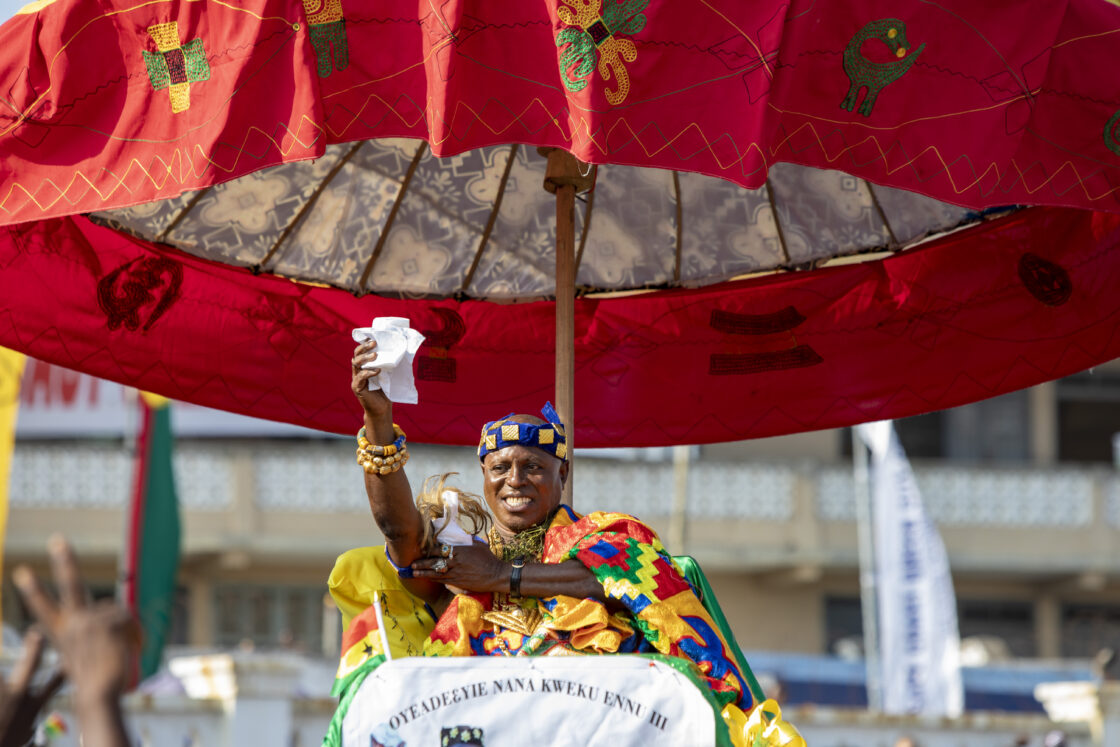
The ceremonial fire is used to cool the special meal that is fed to the gods, the various stools and the ancestors for the second and last time during the festival. Mutton, yams and eggs are the main items, together with schnapps, that the chief linguist offers. Whilst a special group of men and women do the cooking, only the men, led by the chief linguist, are allowed to enter the residence of the gods and stools to offer the ceremonial food. All the richly adorned chiefs of the state, led by the Denkyirahene, ride in their colourful palanquins and proceed to the riverside. The Denkyirahene alights and personally offers a sacrifice of a sheep to the river god as all his chiefs and people look on. After the sacrifices, the Denkyirahene rides in his palanquin to the durbar grounds and sits in state to receive homage from his chiefs and people. Here, one observes royalty, dignity, pageantry, and valour all portrayed in rich culture. Drums beat, horns blow, and executioners recite poems and dance and display in their special robes all in honour of the Denkyirahene as the embodiment of the Denkyira state.
At this crowning durbar, the chiefs, people and invited guests go in a line to shake hands with the Denkyirahene to congratulate him on the sacrifices he has made to ensure prosperity and life for all in the years to come.
The festival might not be fully held yearly because there are so many rituals that have to be performed, and hence the expense. Odwira might not be fully held yearly. Even though the festival cannot be celebrated every year, some necessary rituals are still held. We have mini festivals like “Adae Kesee” and “Mpaatum”. During these mini festivals or occasions, the gods are fed, but not on a wider scale, as it will happen during the Odwira. Most of the rituals performed during the festival are done at night, and they are not to see the light of day; it is a taboo, for example, to whistle during the night because those things would ward off the gods and the ancestors.
Purpose
For feeding the ancestral stools and the gods, also for remembering the dead ancestors and reunions and homecomings for all Denkyira “at home and abroad”. It is also for a rich display of culture and merry-making. It is a solemn religious ceremony to remember the dead.
Nearby Attraction
- Cape Coast Castle
- Kakum National Park
- Fort Amstadam
- Fort St Jago
- Fort Williams
Nearby Accommodation
- Mighty Victory Hotel
- Cottage Na Grill Hotel
- Manest Royal Hotel