

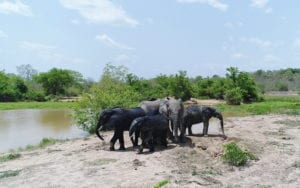
Mole National Park is the largest and most prestigious protected area in Ghana. It is located in the north-west of the country and is Ghana’s largest wildlife refuge, measuring 4,849 sq km. The park has very rich flora and fauna. It is best known for its elephants (a population of about 600) and many other primates.


Wildlife
Some 94 mammal species, over 300 bird species, 9 amphibian species and 33 reptile species have been recorded in Mole. The large, commonly seen mammals include elephants, kob, roan antelope, hartebeest, waterbuck, bushbuck, warthog, buffalo, several duikers, baboon, and roan. Predators include lions, leopards, spotted hyenas, caracals, aardvarks, genets, civets, and mongooses. Occasionally, buffalo overrun the park headquarters and the lodge area.
Birds
The large bird life includes kites and Bateleur eagles, rollers, kingfishers, Egyptian geese, egrets, pelicans and storks. Ground hornbills, flycatchers, malachite kingfishers, guinea fowl and rock partridges occur in large numbers at Mole. There are also more than 300 bird species and 33 identified reptile species within the national park. The park is located on grassland savannah, and its entrance is near the town of Larabanga. The ephemeral rivers Lovi and Mole flow through the park, leaving behind drinking holes in the long dry season.


History
The Mole National Park was established in 1958 and redesignated a national park in 1971. It covers an area of 4,840sq km of undulating terrain with steep scarps. The vegetation is pristine Guinea savanna with gallery forests along the rivers and streams.
Mole National Park was the first wildlife protected area established in Ghana. The park lies within two physiographic regions: 65% within the Voltaian sandstone basin and 35% within the savanna high plains. The topography is generally undulating, with flat-topped hills, dominated by the Konkori scarp, which runs north-south through the park and reaches up to 250m. The park lies within the Volta River catchment, and numerous rivers cross or originate in it, draining into the White Volta River. Mole National Park represents a fairly undisturbed guinea savannah ecosystem dominated by open savannah woodland.
Video
https://youtube.com/watch?v=pck1CpN-yuY
Species of special interest include elephant, buffalo, kob, western hartebeest, roan antelope, Defassa waterbuck, oribi, Bohor reedbuck and red-flanked duiker. The riverine forests are home to rare and endangered species such as the yellow-backed duiker and the black-and-white colobus monkey. The lion, leopard, and hyena are important large carnivores found in the reserve. The buffalo population is of great scientific interest, as both black and red colour varieties occur in the dark. With regard to vegetation, local endemism is generally low in the West African savannah, and only two endemic species, Kyllinga echinata, a sedge, and Ancilema setiferum var pallidiciliatum, confined to northern Ghana, are found in Mole. In addition, three species endemic to Ghana are recorded: Gongronema obscurum, Raphionacme vignei, and Phinopterys angustifolia. Eleven (11) species of mole are confined to the savannah woodland, while Mimusops kammel is a tree that is confined to riverine forests. To date, five species have been identified which have not been recorded elsewhere in Ghana: Croton pseudopulchellus, Indigofera conferta, Indigofera trichopoda, Jatropha neriifolia and Pleiotaxis newtonii. Anthocleista vogelii, a tree of wet sites in the south-western forest zone of Ghana, has been recorded for the first time in Mole. Apodostigma palleus is a climber that is also restricted to the forests in south-western Ghana. Amblygonocarpus andogeness, a savannah tree widespread in central, east and south tropical Africa, has been recorded for the first time in Ghana at Mole. Mole has an important history linked to the national slave trade route project. The ancient caravan route from Salaga to Wa and beyond to Mali passed through the heart of the park. This route was used for both trade and the transportation of slaves to coastal markets. The park headquarters is located right at a place where two famous slave raiders (Samore and Babatu) raided and reduced a village to the ground. The headquarters is named after one of them – Samole. There is a cave in the Konkori escarpment that was used by the local indigenes as a refuge from slave raiders. Other important attractions in the park include Kwomwoghlugu and Asibey pools, wetland areas (unique bird-watching sites), waterfalls on the Koukori escarpments and remains of many old villages destroyed by slave raiders.


Accommodation
The park is also Ghana’s most developed tourism site in terms of tourist amenities. The reserve is home to West Africa’s first luxury safari lodge, nestled in the heart of the Mole forest. Zaina, the country’s premier ecolodge, provides world-class hospitality service with a unique touch.


25 rooms are individual luxury tented chalets, complete with private balconies and indoor and outdoor showers for those who like to bathe under the stars. Zaina is the experience you have been waiting for. Maraba!!! an eco-lodge with 25 chalets, a 33-room motel with a restaurant and swimming pool and a small museum.
Getting there
It is 24 km from Damongo, the district capital, and 146 km southeast of Tamale, the regional capital. The park is 700km from Accra and 430km from Kumasi.
One could get to Mole from Accra by air (Africa World Airlines) to Tamale and then by road. The journey between Tamale and Mole National Park is now paved, greatly reducing journey times.
If coming by public transport from Tamale, you could take a tro-tro (minibus) to Wa and ask to be dropped at Damongo or Larabanga, from where you can get a taxi or motorbike to the park. From Larabanga, you could even hike or bike if there’s enough daylight (one to two hours walking, depending on your level of fitness).
Map
https://visitghana.com/%22https://www.google.com/maps/embed?pb=!1m18!1m12!1m3!1d3935.100362182504!2d-2.002194049127055!3d9.499999993161616!2m3!1f0!2f0!3f0!3m2!1i1024!2i768!4f13.1!3m3!1m2!1s0xfd178aeaaaaaaab%3A0xcd21293ca7ce2c78!2sMole+National+Park!5e0!3m2!1sen!2sgh!4v1540415876236%22
Fringe Communities and Nearby Attractions
There are 33 communities on the immediate fringes of Mole with a total population of about 40,000 people. One of these communities is Mognori, where visitors to Mole are taken to experience the African village life of farming and animal husbandry. Visitors may go out on the Mole River in native canoes and stay with local families to participate in everyday activities like going to the farm with their host and helping with household chores. Another interesting community visited from the Mole National Park is Larabanga, reached on foot or by bicycle, where visitors may stay at a traditional lodge run by the Salia Brothers. The Larabanga village is famous for its 500-year-old mosque, reported to be the oldest in West Africa, with a very interesting history of its origins. One kilometre from Larabanga is the revered sacred stone of the community. It is worth hearing the story behind this stone.
Other attractions:
- Waterfall: The spectacular Konkori waterfalls are located about 100km north-east of the park headquarters. However, access to it is challenging and currently reserved for those out for adventure.
- Slave Caves: A number of caves located in the park are said to have served as hiding places for indigenes who fled the raid of the two notorious slave raiders, Samori and Babatu, who used the current park headquarters location as their base during the era of the slave trade.
- Mole Airstrip